September 7, 2026 · Nextler Team
You Can't Buy a New Gas Turbine Until 2032
If you call a gas turbine manufacturer today and ask for a unit, the honest answer might be "see you in 2032." That is not a sales joke, it is close to what customer conversations already sound like. This is not a story about how big the gas turbine market is becoming. It is a story about whether you can actually get a unit if you need one now, and for most buyers, right now, the answer is no.
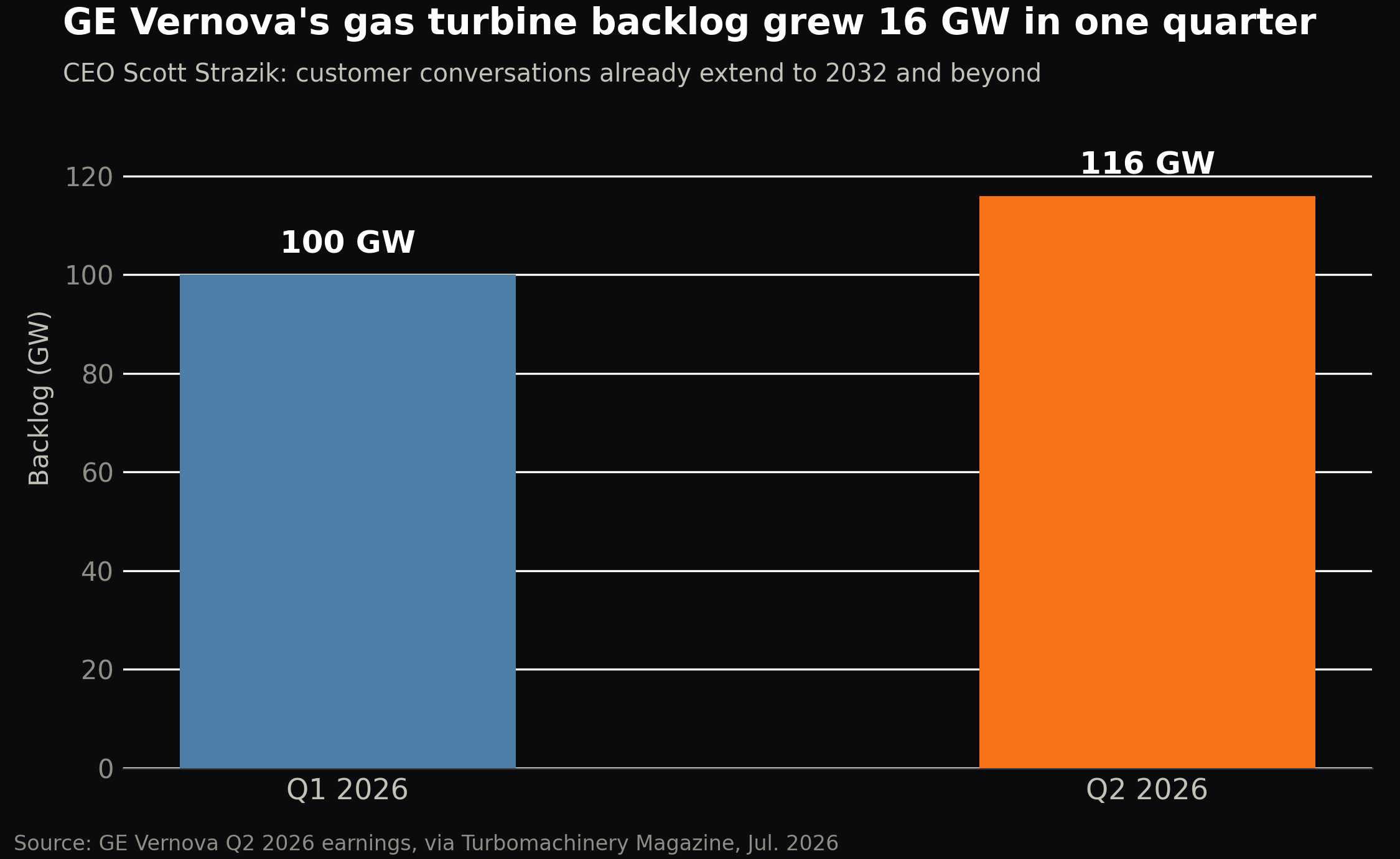
GE Vernova closed the second quarter of 2026 with a gas turbine backlog of 116 GW, up from 100 GW just one quarter earlier, according to Turbomachinery Magazine. The company's Power segment booked $16.7 billion in orders that quarter, up 134% organically year over year, the same report noted. On the earnings call, CEO Scott Strazik told investors that customer conversations already extend to 2032 and beyond. That is not a company having a good quarter. That is a company that has effectively sold out its production capacity for most of the rest of the decade, in real time, while still taking new orders it will not be able to deliver on for years.
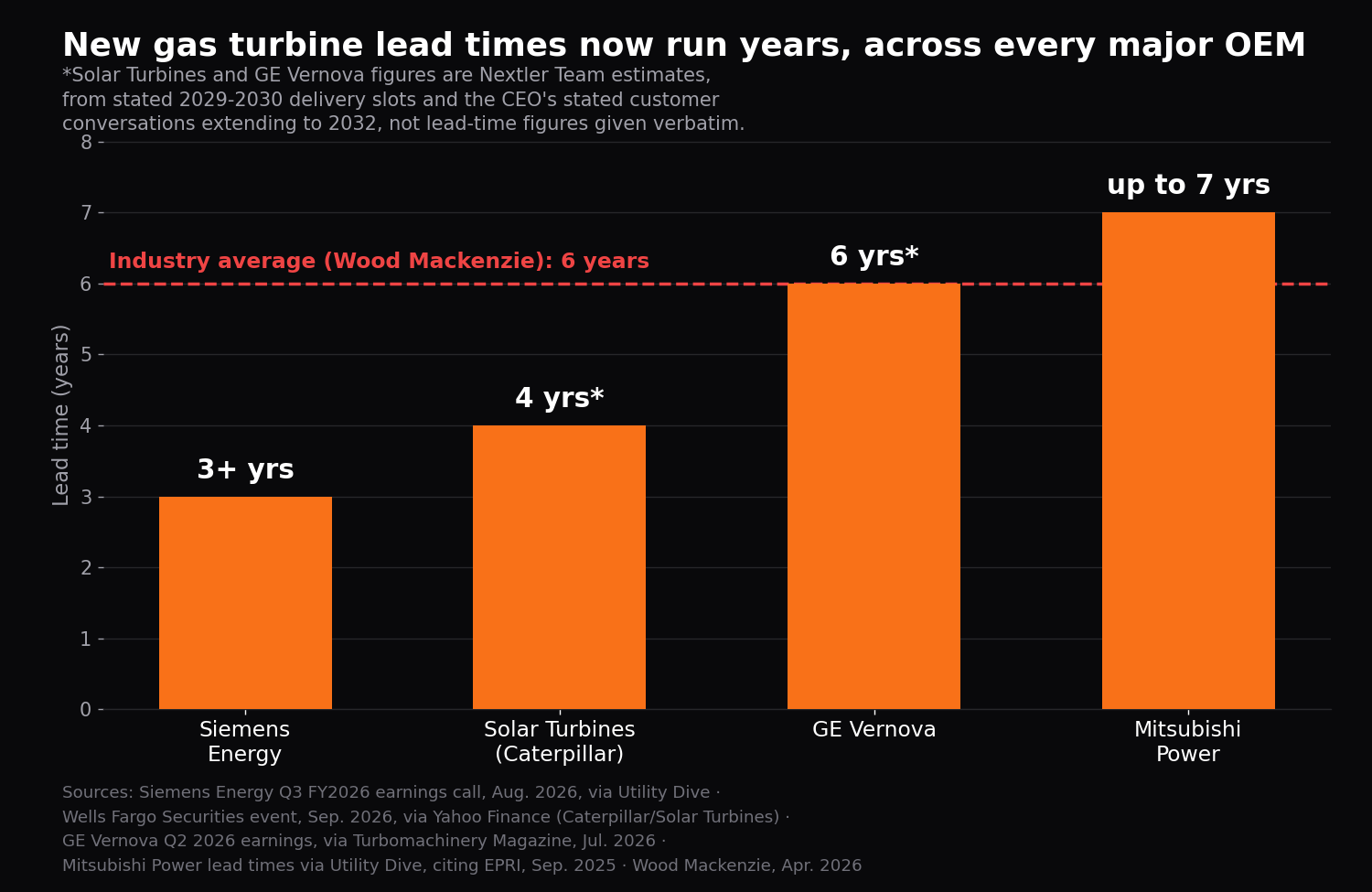
GE Vernova is not an outlier, it is the pattern across the whole industry. Wood Mackenzie's analysis, published April 1, 2026, put global gas turbine orders at 110 GW against a manufacturing base that can only produce 60 to 70 GW a year, according to the Wood Mackenzie report. That gap between demand and factory capacity is why lead times for new units have stretched to six years, and why turbine prices have already risen 195% since 2019, with Wood Mackenzie projecting prices will reach $600 per kW by the end of 2027.
Mitsubishi Power tells the same story from a different angle. As of September 2025, Utility Dive reported, citing EPRI, that Mitsubishi's lead times had stretched from a normal 2.5 to 3 years out to as much as 7 years.
Siemens Energy and Caterpillar, parent of Solar Turbines, confirm the pattern rather than break it. Siemens Energy closed its fiscal third quarter of 2026, the period ending June 30, with a gas turbine backlog of 69 GW, after booking 15 GW in new orders that quarter alone, Utility Dive reported on August 10, 2026. On the earnings call, CFO Maria Ferraro said lead times across the company now run three years or more, while CEO Christian Bruch said Siemens Energy could deliver 15 to 16 GW of turbines this year, meaning its current backlog alone represents more than four years of deliveries at that pace. Caterpillar's turbine business, which includes Solar Turbines, is seeing the same horizon stretch out. At a Wells Fargo Securities event, Caterpillar CEO Joe Creed said the company has "a really strong backlog into the next two years of line of sight, starting to take orders into 2029, even our first order into 2030 on turbines," according to Yahoo Finance. Four manufacturers, four separate reports, one consistent signal: buyers are waiting years, not months, for new equipment, and the wait keeps getting longer, not shorter.
A six or seven year wait is manageable for a utility planning a decade ahead. It is not manageable for a data center operator who needs megawatts online next year, an industrial plant replacing a failed unit on short notice, or an EPC contractor whose client is losing money every month a project sits idle. For buyers like these, "place an order and wait" is not a plan, it is a business risk they cannot absorb, and it is pushing more of them to ask a question they would not have asked two years ago: does this unit have to be new?
Nextler Team Analysis
The number that matters most in all of this is not any single backlog figure, it is the direction every one of them is moving, and how consistent that direction is across manufacturers that otherwise compete hard for the same customers. GE Vernova's backlog did not shrink between Q1 and Q2 2026, it grew by 16 GW in three months, with CEO Scott Strazik describing customer conversations that already stretch to 2032 and beyond. Siemens Energy's CFO points to lead times of three years or more company-wide. Mitsubishi Power's have roughly tripled, from a normal 2.5 to 3 years out to as much as 7. Caterpillar's Solar Turbines business is booking its first 2029 and 2030 delivery slots. Wood Mackenzie's six-year figure sits in the middle of that same spread, an industry-wide pattern rather than a number every OEM has hit on its own. Read individually, each data point is one company's backlog. Read together, four manufacturers and one independent industry analysis are all pointing at the same supply constraint, not four coincidences that happen to rhyme.
We often talk to clients who assumed ordering a new turbine was the safe, default choice, until they ran the math on what a delivery date measured in years, not months, actually does to their project. In that context, a well-documented used unit with known runtime hours and a clear maintenance history stops being a fallback and becomes the option that matches how fast the buyer actually needs power. That is exactly the conversation we are having with nearly every serious buyer who reaches out to us right now, in the same sub-30 MW range where Nextler's inventory sits. When the factory's answer runs three to seven years out no matter which nameplate is on the unit, the secondary market's answer is "this quarter," and for most buyers, that difference decides the project.
If your timeline can't wait until 2032, talk to our team about what is available now.